


A RevOps Framework for Fixing a Leaky Sales Pipeline
Smarter Systems. Better Sales.
Reduce Friction
Support Growth
Improve Alignment
Deals are supposed to move through a pipeline.
But in many organizations, they don't.
Leads stall. Opportunities disappear. Forecasts feel unreliable. And revenue quietly leaks out of the system long before anyone notices.
When that happens, the problem usually isn’t effort or execution. It’s the system behind the pipeline.
That’s exactly what a strong RevOps Framework is designed to fix: The flow of deals through your pipeline.

When a pipeline leaks, you don't push the water harder.
You fix the pipe.
That’s the philosophy behind Smarter Systems. Better Sales.
Instead of pushing teams harder or adding more tools, SSBS focuses on fixing the pipe — the systems, data, and workflows that determine how deals actually move through your pipeline.
Below, we break down what a modern RevOps Framework looks like, why pipelines leak in the first place, and how smarter system design restores predictable flow.
What is a Modern RevOps Framework?
A modern Revenue Operations (RevOps) Framework gives Sales, Marketing, and Customer Success a shared way of working. It unifies how information flows, how handoffs happen, and how teams understand the customer journey. In simple terms, a RevOps framework connects people, processes, data, and technology into a single, coordinated system.
Instead of each department running its own playbook, the organization moves forward in one direction.
Why revenue teams need a shared RevOps framework
Many revenue teams work hard but still struggle with predictable results:
-
Systems don’t talk to each other …
-
Processes drift …
-
Data tells different stories depending on which tool you open.
Over time, the entire revenue engine starts to feel heavier than it should.
Why this framework matters for leaders
Healthy systems produce healthier revenue. A strong framework improves:
-
Confidence in data
-
Clarity across the pipeline
-
Consistency in how work gets done
-
Predictability in forecasting
-
Speed in decision-making
Leaders get the visibility they need to guide the business, instead of chasing down answers from disconnected tools.
A framework built for the full Lead-to-Revenue cycle
A modern RevOps framework extends beyond sales execution. It strengthens how:
-
Marketing attracts and qualifies demand
-
Sales manages opportunities and builds momentum
-
Customer Success drives renewals and expansion
Everyone contributes to the same goals. Everyone works from the same source of truth. And everyone understands how their work impacts the overall customer experience.

Where “Smarter Systems. Better Sales.” fits into your RevOps framework
“Smarter Systems. Better Sales.” (SSBS) is our structured method for building a modern RevOps framework that simplifies tools, aligns workflows, and supports clear, confident decision-making. The details change from one organization to another, yet the core principles stay the same: Better systems, better visibility, and better sales outcomes.
With that foundation in place, the next step is understanding why revenue systems break down so often and what leaders can do to rebuild them wisely.
Why Revenue Systems Break Down
Too many disconnected tools
When tools don’t talk, teams compensate.
As organizations grow, they add new systems to solve emerging problems. Each one brings its own data model, workflow, and user experience. Over time, Sales, Marketing, and Customer Success end up working in separate environments that rarely line up.
In real life, this looks like:
-
Teams checking multiple systems to piece together customer history
-
Screenshots and spreadsheets filling the gaps
-
Different tools showing different versions of the truth
Disconnected tools eventually create more friction than they solve.
We’ve seen this pattern play out in real teams, and several of our CRM Horror Stories explore exactly why CRM projects fail when systems don’t work together.

Inconsistent processes across teams
When processes drift, alignment breaks.
Marketing qualifies leads one way. Sales follows a different sequence. Customer Success handles onboarding based on what “usually works.” These variations feel small, yet they disrupt how information flows and how predictable the revenue engine feels.
Without a shared process, teams develop their own interpretations of the work, hand-offs are more difficult, and consistency becomes difficult to maintain.
Data that can't be trusted
Leaders can’t guide the business if they don’t trust the numbers.
Most data issues are quiet and incremental, but they build overtime:
-
Manual entry introduces errors
-
Fields are used differently across teams
-
Sync issues create multiple versions of truth
-
Critical information lives outside the CRM
When the data becomes unreliable, decision-making slows down and forecasting becomes guesswork.
Manual work slows down the pipeline
Manual work expands to fill every gap in the system.
Sellers enter the same information in multiple places. Marketing moves data between tools by hand. Customer Success retypes updates into spreadsheets. Each step feels small, but the cumulative effect is significant.
For example:
A sales rep who loses 30 minutes each day for admin work loses more than 130 hours of selling time each year. Multiply that across a team, and momentum erodes quickly.
Manual work doesn’t just slow you down, it creates uneven execution and inconsistent results.
Poor handoffs between Marketing, Sales, and Customer Success
Handoffs are where momentum is gained or lost.
Even when a lead is strong or a customer is excited, the transition between teams can create friction. Missing context, unclear expectations, and incomplete information all contribute to delays and frustration.
This often shows up as:
-
Leads passed with gaps
-
Opportunities losing traction after handoff
-
Onboarding teams lacking key customer details
Customers feel these gaps immediately, and teams expend unnecessary effort trying to recover momentum.
Automation that never sticks
Automation fails when the surrounding system isn’t ready for it.
Many organizations attempt to automate broken processes, and the result is automation that breaks quietly or fires inconsistently. When teams lose trust in these workflows, they revert back to manual steps.
The issue isn’t the automation; it’s the lack of alignment in the data, process, and systems that surround it.
Reliable automation requires a stable foundation.
Systems not designed for AI readiness
AI can’t fix a broken system - it amplifies it.
Leaders want to understand where AI can help, but the real question is whether their underlying systems are prepared to support it. If data is messy and workflows are inconsistent, AI surfaces unreliable insights and suggestions.
This is why teams often feel unsure about AI adoption even when the potential is clear.
AI benefits organizations that already have strong system foundations.
Growing teams outpace their systems
The system that supported the business at $10M won’t support it at $100M.
Growth introduces new complexity - more leads, more roles, more product lines, more customer interactions. The systems that once worked well begin to lag behind the business.
Teams introduce shortcuts to keep up, processes diverge, and visibility shrinks as workarounds increase.
Growth exposes system weaknesses faster than teams can adapt.
The Core Principles of a Modern RevOps Framework
A strong RevOps framework gives revenue teams clarity, alignment, and confidence. These principles guide how smarter systems are designed, improved, and used across the entire lead-to-revenue cycle. They create a structure that helps teams work more effectively and gives leaders the visibility they need to steer the business with certainty.
Data should:
-
Have ONE source of truth
-
Be consistent
-
Create actionable insights
Workflows should:
-
Be intuitive
-
Support clear processes
-
Have clear ownership
Systems should:
-
Simplify work
-
Scale with business growth
-
Improve continuously
Data should have one source of truth
One version of truth keeps everyone aligned.
Teams make better decisions when they all look to the same place for customer information, deal history, and performance insights. A single source of truth reduces confusion, accelerates collaboration, and prevents the constant back-and-forth over which dataset is correct.
Data should be clean, consistent, and shared across teams
Trusted data drives stronger decisions.
Marketing, Sales, and Customer Success rely on accurate information to understand pipeline health, customer needs, and performance trends. When each team works with different data or different definitions, the entire revenue picture becomes blurry. Consistent data unifies the organization and builds confidence in reporting.
Data should create actionable insights
Leaders need visibility they can trust.
Stale reports and outdated dashboards slow decision-making. Real-time insights help leaders respond quickly to opportunities and risks. When teams understand what is happening now, not what happened last month, they can operate with more confidence and agility.
Workflows should be intuitive and predictable
Easy-to-follow processes keep teams aligned.
If a workflow is confusing or difficult to remember, it won’t be followed consistently. Revenue teams benefit from clear, predictable processes that guide how work moves from one stage to the next.
Intuitive workflows reduce training time, improve adoption, and ensure customer experiences stay consistent.
Workflows should support clear, stable processes
Automation is a multiplier - not a bandage.
Workflow automation becomes effective when the underlying steps are clear, stable, and aligned across teams. When used well, automation reduces manual work, improves handoffs, and supports more consistent customer experiences.
Automating a broken process only speeds up the breakdown.
Workflows should have clear ownership
Clear ownership prevents system drift.
When no one owns a workflow, it evolves on its own. Steps get added informally, removed quietly, or change based on individual habits. Assigning ownership ensures processes stay aligned, healthy, and up to date as the business grows.
Systems should simplify work, not make it harder
The best systems remove friction.
A modern revenue engine depends on tools and processes that make work easier, not harder. When systems are complicated, teams create shortcuts, workarounds, and inconsistent habits that reduce efficiency. Simple systems create clarity, streamline decisions, and support better execution.
Systems should scale with business growth
Systems must keep pace with growth.
What works for a small team often breaks under higher volume or more complex operations. Scalable systems allow teams to grow without sacrificing consistency, visibility, or customer experience.
Well-designed systems expand naturally as demand increases.
Automating a broken process only speeds up the breakdown.
Systems should improve continuously
Strong systems evolve with the organization.
The best revenue engines are never static. As markets shift, products expand, and customer needs change, systems should adapt with them. Continuous improvement keeps the RevOps framework healthy and ensures the business remains agile, aligned, and ready for what comes next.
Ongoing Support & Maintenance helps keep these improvements steady, sustainable, and aligned with your revenue goals.
How System Design Drives Revenue
A well-designed RevOps system does more than support daily activity. It improves how teams work, how information flows, and how leadership guides the business.

When systems create clarity instead of friction, revenue performance follows. These are the outcomes most organizations feel once they adopt a modern, aligned framework.
Higher quality pipeline and stronger lead conversion
Clarity improves qualification and momentum.
When Marketing, Sales, and Customer Success follow the same definitions and workflows, leads move through the funnel with more consistency. Handoffs are clearer, qualification is more accurate, and opportunities enter the pipeline with better intent.
Well-designed systems:
-
Reduce early-stage drop-off
-
Provide cleaner lead scoring
-
Improve how teams prioritize follow-up
-
Help Sales focus on the right accounts
Higher quality leads naturally convert at a higher rate.
Faster sales cycles with fewer delays
Aligned systems remove friction at every stage.
Sales cycles slow down when information is missing, steps are unclear, or tools don’t support the process. A strong RevOps framework reduces these delays by aligning workflows, centralizing information, and helping teams see exactly what needs to happen next.
When reps have what they need - consistently and in one place - opportunities move faster and with less effort from the team.
More accurate forecasting and better visibility
Leadership needs clarity to guide the business.
Forecasting breaks down when data is inconsistent or teams follow different processes. Clean systems, shared definitions, and predictable workflows give leaders a clear view of what is real, what is at risk, and where attention is needed.
Better visibility creates:
-
Stronger forecasting accuracy
-
More confident planning
-
Better resource allocation
-
Fewer late-stage surprises
Accurate forecasting isn’t luck.
It’s the result of healthy systems.
Better productivity with less administrative work
When systems do the heavy lifting, teams stay focused.
Administrative work steals time from high-value activities. Reps update multiple systems. Marketing manages manual workarounds. Customer Success copies data into spreadsheets because the process doesn’t fully support their workflow.
A well-designed system reduces time spent on repetitive tasks and frees teams to focus on what matters most - engaging customers, advancing deals, and delivering value.
Improved productivity is a direct outcome of simpler, smarter systems.
Improved customer experience across the entire lifecycle
Aligned systems create a smoother journey for every customer.
When information is consistent and workflows connect across Marketing, Sales, and Customer Success, customers experience a more seamless progression from first touch to renewal.
This reduces friction in:
-
Lead qualification
-
Sales conversations
-
Onboarding
-
Account management
-
Renewal and expansion cycles
Strong system design ensures customers receive consistent communication, context, and support at every stage.
Higher adoption of CRM, automation, and AI tools
People trust systems that make their work easier.
Adoption increases when tools align to real workflows, information is accurate, and the system supports the way they actually work. Good system design builds trust, and trusted systems get used.
This creates the foundation for:
-
Effective automation
-
Stronger reporting
-
Meaningful AI insights
-
Better collaboration across teams
AI becomes far more valuable when the underlying system is aligned, clean, and stable.
SSBS + Power Platform = Agile Revenue Systems
The Power Platform plays a critical role in bringing the SSBS framework to life. It gives organizations a unified, flexible foundation to automate processes, standardize workflows, and adapt quickly as their business evolves.

A unified platform that supports your entire revenue engine
One foundation reduces complexity across teams.
Power Platform brings Marketing, Sales, and Customer Success onto a shared platform with consistent data structures, shared workflows, and a common language for customer information. This unification reduces tool sprawl and provides a more stable environment for process improvements.
Instead of working around the system, teams finally operate inside the same one.
Dataverse as the single source of truth for customer information
Clean, consistent data improves every part of the revenue cycle.
Dataverse centralizes customer, account, opportunity, and activity data so every team works from one version of truth. This eliminates the fragmented records, manual exports, and conflicting reports that undermine confidence in the system.
A single source of truth keeps teams aligned and focused on action instead of fixing bad data.
Low-code tools that adapt to your process, not the other way around
Your systems should evolve as your business grows.
With low-code capabilities like Power Apps and Power Automate, teams can design pages, forms, and workflows that match real processes. This flexibility allows organizations to make improvements quickly, without waiting for lengthy development cycles or expensive customizations.
The system becomes a living part of the business, not a barrier to progress.
For organizations using Dynamics 365 and the broader Microsoft ecosystem, the Power Platform becomes the natural foundation for putting this framework into practice.
Automated workflows reduce manual effort and improve consistency
Automation is most valuable when it supports clear processes.
Power Automate helps revenue teams eliminate repetitive tasks, improve handoffs, and enforce key steps in the customer journey. Activities are created automatically. Notifications are sent at the right time. Data stays consistent from one stage to the next.
This reduces administrative work and ensures teams follow the same playbook every time.
Seamless integration across Marketing, Sales, and Customer Success
Integrated systems create a smoother experience for teams and customers.
Power Platform offers a broad set of connectors and APIs that allow information to move easily between tools. Marketing automation, customer portals, CPQ systems, onboarding tools, and support platforms can all tie into the same revenue architecture.
When systems stay in sync, teams collaborate more effectively, and customers experience fewer missteps throughout their journey.
A strong foundation for AI, Copilot, and future automation
AI is most effective when built on clean, aligned systems.
Power Platform provides the consistency, structure, and data quality needed for AI to deliver real value. Whether it’s Copilot for Sales, predictive scoring, or workflow suggestions, AI becomes more reliable when the underlying processes are stable, and the customer information is accurate.
This foundation prepares organizations for the next wave of automation and insight-driven selling.
SSBS + Customer Insights = Smarter Decisions
Strong systems don’t just streamline work; they help teams make better decisions.
The SSBS framework depends on clear customer insights that span the entire lifecycle. These insights can come from Microsoft Dynamics 365 Customer Insights, ERP/CRM integration, or the tools an organization already has in place.

What matters most is that leaders can understand their customers, act with confidence, and guide the revenue engine with clarity.
Clear customer profiles that support full lifecycle understanding
Better decisions come from seeing the whole picture.
Whether the organization uses Customer Insights, ERP/CRM integration, or an existing data foundation, revenue teams need a complete view of customer interactions. When Marketing, Sales, and Customer Success all see the same context, they coordinate more effectively and serve customers with greater consistency.
This creates a smoother experience and reduces the gaps that often appear during handoffs.
Insightful reporting that improves decision-making
Leaders need visibility they can trust.
Clean, accessible reporting helps teams understand what is happening across the revenue cycle. It shows where deals stall, which segments respond well to outreach, and where customers may be at risk. Strong system design ensures these insights are accurate, easy to interpret, and relevant to how teams work.
Clear reporting turns data into action.
Predictive signals that surface risks and opportunities early
Forward-looking insights help teams stay ahead.
A healthy revenue system offers early indicators of momentum or concern such as deal engagement patterns, customer behavior changes, or renewal risks. Predictive signals help teams prioritize their time, adjust strategies, and support customers proactively.
This supports a more stable, resilient revenue engine.
Some organizations use Microsoft Dynamics 365 Customer Insights to support this layer of intelligence, while others rely on ERP/CRM integration or existing analytics and reporting tools. SSBS adapts to each environment.
Segmentation and targeting strengthens go-to-market performance
Relevant messaging creates stronger engagement.
Strong segmentation helps Marketing reach the right audience with the right message, while Sales focuses on accounts with higher likelihood to convert. These insights can come from Customer Insights, Dynamics 365 Sales, or existing data systems.
When segmentation is clear and confident, every part of the Go-to-Market motion becomes more effective.
Clean data that supports AI and automation reliability
AI only works when the underlying data is healthy.
Inconsistent, incomplete, or duplicated data can limit the effectiveness of AI and automation. SSBS helps organizations create a cleaner, more structured foundation so AI suggestions, Copilot prompts, and automated workflows behave predictably.
Cleaner data amplifies the value of every future investment in intelligence and automation.
A connected view of the revenue engine across tools and systems
Visibility improves alignment at every stage.
A modern RevOps framework brings together signals from multiple tools - CRM, ERP, marketing automation, onboarding systems, support platforms - so teams can understand how customers move through the full lifecycle. This connected view reduces blind spots and strengthens collaboration across departments.
When insights flow freely, the entire revenue engine performs better.
How AI Amplifies a Modern RevOps Framework
AI becomes most valuable when it sits on top of clear processes, clean data, and well-aligned systems. The SSBS framework creates the foundation AI needs to deliver accurate insights, reduce administrative work, and guide teams toward better decisions.
With the right structure in place, AI becomes a force multiplier for every part of the revenue engine.
Clean, structured data increases AI accuracy and reliability
AI works best when the underlying system is healthy.
Poor data quality leads to weak predictions, irrelevant suggestions, and inconsistent outcomes. When information is structured, consistent, and shared across teams, AI can analyze patterns more accurately and deliver insights that teams trust.
AI’s full potential is unlocked by a strong system.
If you’re exploring how AI changes the revenue cycle, our recent articles on AI’s impact on revenue systems offer deeper analysis and real-world examples.
AI-enhanced lead scoring improves prioritization and focus
Smarter scoring helps teams spend time where it matters most.
AI can evaluate buyer intent, engagement patterns, and historical performance to score leads more precisely than manual methods. This helps both Marketing and Sales identify higher-quality opportunities, improve follow-up timing, and reduce wasted effort on low-intent leads.
Better Scoring -> Better Conversion -> Better Sales
Intelligent routing ensures faster, more accurate handoffs
AI improves the flow of work across the revenue cycle.
Using signals from engagement history, geography, deal attributes, and past behavior, AI can ensure leads and opportunities reach the right person at the right time. This reduces delays, improves customer experience, and helps teams respond with greater speed and precision.
Handoffs become smoother and more reliable.
Predictive forecasting strengthens revenue planning
AI adds confidence to leadership decisions.
Predictive models analyze pipeline quality, deal momentum, buyer activity, and historical patterns to forecast revenue with greater accuracy. Leaders gain a clearer view of risk, opportunity, and expected outcomes - without relying solely on manual updates or subjective judgment.
Better forecasts support better planning at every level.
Next-best-action suggestions help teams maintain momentum
AI guides sellers, marketers, and Customer Success toward the next step.
From recommending follow-up timing to suggesting helpful content or identifying accounts that need attention, AI helps teams stay proactive. These insights support consistent execution and keep opportunities moving forward.
Momentum is easier to maintain when guidance is built into the workflow.
Automated activity capture reduces administrative work
When AI handles the details, teams stay focused on customers.
AI can capture emails, meetings, notes, and interactions automatically - eliminating the repetitive administrative work that slows productivity. This keeps CRM records up to date without asking teams to spend extra time entering data manually.
Accurate data improves visibility and strengthens reporting.
AI becomes more valuable as systems mature
Healthy systems create better AI outcomes.
As organizations refine their processes, clean up data, and strengthen system alignment, the value of AI compounds. Insights become sharper. Recommendations become more relevant. Forecasts become more reliable. The better the system, the better the AI.
A strong RevOps framework ensures AI becomes a strategic advantage, not a distraction.
Bring SSBS to Life in Your Organization
Transforming your revenue engine doesn’t require a massive overhaul or a risky leap.
It begins with clarity, structure, and a thoughtful sequence of steps that help your teams understand where they are today and how to move forward confidently. SSBS provides the framework. These steps help bring it to life inside your organization.
Start with a clear understanding of your current systems
Clarity creates the foundation for improvement.
Before making any changes, it’s important to understand how your tools, data, and workflows function today.
This includes what’s working well, where effort is duplicated, and how teams experience the system in their daily work. By aligning around the current state, leaders gain a shared perspective and avoid making assumptions that lead to rework later.
A clear baseline allows every improvement to be intentional and grounded in reality.
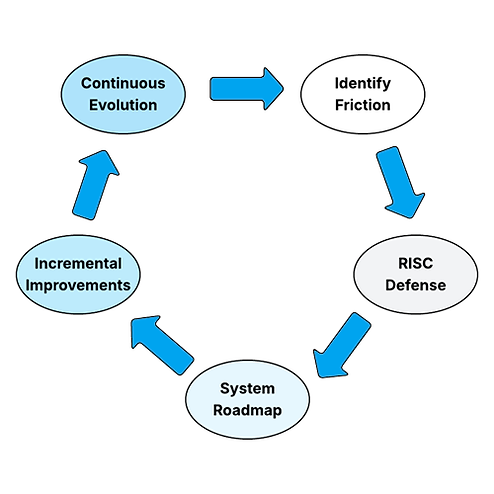
Where is the friction in your revenue engine?
Friction slows down your team. identifying friction unlocks momentum.
Every revenue engine develops friction over time. Disconnected tools, inconsistent handoffs, unclear processes, and manual work all contribute to bottlenecks that limit performance.
Understanding exactly where these breakdowns occur helps leaders pinpoint the most meaningful areas to improve first.
Start with a low-risk RISC Defense assessment
A structured discovery reduces uncertainty and builds confidence.
The RISC Defense Program gives you a guided, low-risk way to understand your environment with clarity. Through a structured evaluation of risks, issues, symptoms, and consequences, teams gain a neutral, well-organized view of their system’s health.
The RISC Defense Program provides the insight needed to move forward wisely without committing to large-scale changes before you’re ready.
Build a roadmap to align teams and technology
A clear plan keeps everyone moving in the same direction.
Once you understand your environment and the friction within it, the next step is building a practical roadmap. This roadmap outlines priorities, identifies the sequencing of improvements, and aligns teams around shared goals. It becomes the reference point for stakeholders across Marketing, Sales, Customer Success, and Operations.
A good roadmap connects strategy to action and sets the stage for meaningful, coordinated progress.
Incremental improvements get faster results
Small, well-built enhancements create momentum.
Organizations often see the biggest gains from focused, timely improvements rather than large, multi-month projects. Incremental updates to workflows, data structures, dashboards, or handoffs can deliver immediate value while building trust across teams.
This approach also reduces change fatigue and helps teams adjust steadily without disruption.
Continuous improvement creates a stronger revenue engine
Strong systems evolve with the business.
Revenue engines don’t stay healthy on their own. As markets shift, teams grow, and processes mature, systems need ongoing refinement. Continuous improvement ensures that tools, workflows, and data remain aligned with the company’s goals.
Over time, this steady evolution creates a stronger, more resilient revenue engine - one that consistently supports smarter systems and better sales.
Start Building Smarter Systems Today
A modern revenue engine isn’t built through guesswork or disconnected improvements. It comes from understanding where friction exists, clarifying your next steps, and choosing a path that supports both your teams and your long-term strategy. SSBS gives you the framework — now it’s time to decide where to begin.
Where is your revenue pipeline breaking down?
Every organization has friction.
Take a step back and look at your systems with fresh eyes. Where are teams slowed down? Where do handoffs break? Where does data get messy?
These gaps aren’t just operational issues. They impact customer experience, seller productivity, and revenue performance. Identifying them is the first step toward building a smarter, more resilient system.
A moment of honest reflection often reveals the clearest opportunities for improvement.
Start with a low-risk RISC Defense assessment
When the path forward feels complex, a structured review brings clarity.
The RISC Defense Program gives you a guided, no-pressure way to evaluate the health of your revenue systems and identify where friction is slowing things down.
It highlights risks, uncovers issues, and surfaces the symptoms and consequences that affect day-to-day execution. Most importantly, it brings your teams into alignment without requiring any large commitments or immediate changes.
This is the simplest, safest way to understand what needs attention - and why.
Partner with Optrua to design smarter revenue systems
When you’re ready to move forward, we’re ready to help.
Optrua specializes in building smarter systems that improve sales performance, strengthen data quality, and remove friction across the entire revenue cycle. Whether you need help designing your roadmap, improving your CRM, aligning your teams, or preparing for AI-driven automation, we become your partner in steady, sustainable transformation.
You don't have to do this alone. Smarter systems and a healthier pipeline are within reach.
A low-risk assessment that reveals your strengths, gaps, and next steps.
Frequently Asked Questions
About RevOps Framework
Curious about what the RevOps Framework can do for your organization?
Here are a few common questions we hear from business leaders.

1. How long does it take to see results from a RevOps framework like SSBS?
Most organizations begin seeing improvements within the first few weeks, especially in areas like data cleanliness, workflow consistency, and seller productivity. Larger gains such as improved forecasting, reduced friction between teams, and more reliable reporting often appear within the first 60 to 120 days.
The timeline depends on the current health of your systems, how aligned your teams are, and the pace at which changes are implemented. SSBS is designed to create meaningful early wins while building toward long-term transformation.
2. Do we need Microsoft Dynamics 365 or Power Platform to use a RevOps framework?
No. A RevOps framework is not tied to any specific platform.
SSBS works across a wide range of CRM, marketing automation, and customer success systems. While organizations using Dynamics 365 and Power Platform often see additional benefits such as tighter integration, better AI readiness, and easier automation. SSBS adapts to your existing environment.
The priority is having clear processes, reliable data, and systems that support how your teams work.
3. Can a RevOps framework work with our existing sales and marketing systems?
Yes. SSBS is intentionally platform-agnostic. It focuses on aligning processes, improving data quality, and strengthening the way teams collaborate across the revenue cycle.
Whether you’re using Dynamics 365, Salesforce, HubSpot, industry-specific tools, or a mix of systems, SSBS can help you reduce friction and simplify the customer journey.
You don’t need to replace your systems to benefit from a RevOps framework, you just need structure and clarity.
4. How does a RevOps framework support AI readiness and automation?
AI performs best when it operates on clean data, well-defined processes, and consistent workflows. This is exactly what a RevOps framework provides.
By improving system alignment and eliminating manual inconsistencies, SSBS strengthens the foundation needed for AI-powered capabilities like:
-
Predictive scoring
-
Intelligent routing
-
Automated activity capture
-
Next-best-action guidance
-
Forecasting insights
With a stable framework in place, AI becomes more accurate, more reliable, and far more valuable to your teams.
5. What makes SSBS different from other RevOps frameworks?
SSBS is built for organizations that want clarity, flexibility, and steady improvement without unnecessary complexity.
Unlike traditional RevOps approaches that can feel rigid or overly process-heavy, SSBS emphasizes:
-
Practical system alignment
-
Clean, structured data
-
Continuous improvement
-
Faster incremental wins
-
Readiness for AI and automation
Technology that adapts to your business, not the other way around
It’s approachable, easy to understand, and designed for real teams doing real work.
6. What causes most RevOps frameworks to fail?
Most frameworks fail because they try to fix symptoms instead of addressing root issues. The most common causes include:
-
Unclear processes
-
Poor system adoption
-
Inconsistent data
-
Disconnected tools
-
Misaligned teams and goals
-
Lack of phased improvement
-
Too much focus on technology, not enough on behavior
SSBS is intentionally built to avoid these pitfalls by focusing first on clarity, friction removal, and continuous improvement.
7. How does a RevOps framework improve alignment across Marketing, Sales, and Customer Success?
A strong RevOps framework gives every team a shared view of the customer, a common language for processes, and clear expectations for handoffs and accountability.
It unifies:
-
Data
-
Workflows
-
Reporting
-
Goals
-
System usage
-
Customer experience standards
When teams operate from the same foundation, friction decreases, collaboration increases, and the entire revenue engine becomes stronger and more predictable.